Anxiety About Women’s Age and Sexual Viability
Bridget Jones: Mad About the BoyAnxiety About Women’s Age and Sexual Viability is the pressure to treat a woman’s age as a public measure of her desirability and romantic prospects. In Bridget’s diary, that pressure appears both as blunt social judgment and as an anxious inner calculation: whether a younger partner will be embarrassed by an older woman, whether being single signals personal failure, and whether appearance can keep age from being read at all. The novel gives these fears comic exaggeration, but its recurring contrasts reveal a serious asymmetry: men’s renewed romantic prospects are presented as ordinary, while women are urged to disguise age or risk being considered no longer viable.
Age as a Public Verdict
Bridget’s dilemma about taking Roxster to Talitha’s sixtieth birthday party makes the conflict concrete. She wants to attend because Talitha has been her friend since their Sit Up Britain days, and bringing Roxster could puncture the patronizing pity directed at single women of a certain age. His youthful, peach-like appearance also seems to offer Bridget a temporary rebuttal to her own awareness of ageing. But the imagined victory carries its own humiliation: Roxster might feel treated as a joke or an anti-ageing device, or be put off by a party full of older people. Bridget even pictures him preferring a gathering of young friends, and fears that he would see her as old enough to be his mother—or, in her spiralling thought, grandmother. The party becomes less a simple social invitation than a test of whether the relationship can withstand the age difference as other people might interpret it.
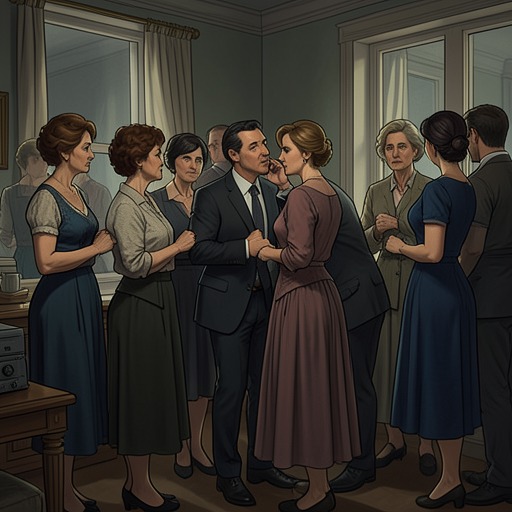
That private fear echoes the public language used around single women. At a gathering, Cosmo insists that a widow cannot wear widow’s weeds forever, while Woney describes how difficult it is for middle-aged women who find themselves single. Bridget objects to the label, but the correction does not free her from its force. When the men compare the attention received by a newly single man with the prospects of a woman Bridget’s age, they describe older women as a diminished market: a man is supposedly inundated with offers, while no one is said to be knocking at Bridget’s door. Cosmo makes the comparison sharper by imagining that a middle-aged man with a house, an income, and two helpless children would attract people wanting to care for him. The same circumstances, attached to Bridget, are treated as liabilities. Her protest falters into self-consciousness when she realizes that middle age is, arithmetically, the middle of life; what she rejects is the expression’s implication of being past it and no longer sexually viable.
Rebranding and the Work of Appearance
Talitha offers a determined answer to this social verdict: do not accept the signs by which age is recognized; change them. She argues that women should avoid presenting themselves as unviable through repeated talk about years without a date, and invokes Germaine Greer’s disappearing woman as something to be rejected. Her programme of rebranding turns confidence and allure into a deliberate presentation. In her account, a body can be made to resist the positioning of middle age, wrinkles can be treated as unnecessary, and abundant, shining hair can help turn back the clock. Tom’s interruption about hair purchased from impoverished Indian virgins punctures the apparent glamour, exposing the costs and compromises that the makeover rhetoric leaves at its edges.
The advice is not simply dismissed. Bridget has already imagined the social usefulness of appearing younger, and the narrative shows why Talitha’s prescription has an audience: labels and judgments make appearance seem consequential. Yet the prescription risks making women responsible for defeating a standard imposed on them. Woney offers a pointed contrast. When Cosmo speaks of younger women and describes the supposedly desirable body, Woney’s eyes flash with pain. The narration distinguishes her from Talitha’s programme of rebranding: Woney has let her hair go grey and short and does not define herself by appearance or sexuality. Her choices are associated with personal honesty, self-belief, and the possibility of being loved for who she is. That possibility sits uneasily beside Cosmo’s careless assumptions, so the contrast does not make the pressure disappear; it shows that women may refuse its terms while still being hurt by them.
Unequal Dating Prospects
The novel also frames age as a question of unequal power rather than an individual woman’s failing. Bridget sketches a rough dating chronology in which women have the upper hand in their twenties because they attract widespread sexual interest, while young men may not yet have established careers. In the thirties, she says, the balance shifts: women face a biologically unfair ticking clock, while men are advancing professionally and can sense the change in their advantage. Her speculation that egg-freezing might turn that alarm into a silent digital clock makes the anxiety comic, but the image identifies its cause as more than personal insecurity. Romantic opportunity is shaped by expectations about fertility, careers, and which sex is presumed to have time on its side.
The newspaper article Bridget reads, The Tragic Fate of the Toy Boy, gives the same imbalance a sensational public voice. It portrays older women who pursue younger men as predatory cougars, even as it lists the advantages they supposedly seek: youth, energetic sex, and companionship without the burdens attributed to older men. The article’s framing makes the older woman conspicuous and suspect, while presenting the younger man as the object of a choice that requires explanation. Its language sits alongside the men’s assumptions at the party: women’s age is treated as a qualification that must be defended, while men’s romantic prospects are discussed as if they naturally expand after a separation.
Beauty, Media, and Self-Surveillance
The pressure also enters ordinary routines. Bridget reads a report criticizing Jessica Biel for wearing a pantsuit judged insufficiently sexy and asks whether women are now assessed by how far their clothes fall from sexiness. She resents the limited model offered by red-carpet culture: women appear in borrowed clothes, are photographed, and then seem to disappear until the next public appearance. Yet she also wishes she could occupy that role. After buying Grazia, she concludes that her own style is outdated and wrong and makes a new list of clothes and accessories for the school run, from skinny jeans and ballet pumps to a large handbag and sunglasses. The episode shows how criticism of the media ideal and participation in its demands can coexist: awareness does not prevent the ideal from reorganizing the way Bridget sees herself.
The bodily stakes are explicit when Daniel arrives with unsuitable gifts and comments that Bridget has been on a diet. Bridget reflects on how differently people treat someone who is fat and someone who is not, or someone dressed up and someone simply looking normal. Her analogy imagines a world of short, green, fat creatures whose advertising celebrates only tall, thin, yellow ones, airbrushed to make them still more extreme. The image makes the gap between ordinary bodies and idealized representations absurdly visible, while showing how constant comparison can make ordinary appearance feel like failure.
By June, the same wish to alter visible signs of age has reached Botox. Bridget reassures herself that many people have it and that it is not the same as a facelift, remembering Talitha’s comparison with a visit to the dentist. Yet she descends into a basement off Harley Street feeling as though she is going to a back-street abortionist and worries that she might look weird. The gap between the casual reassurance and her apprehension condenses the novel’s larger tension: beauty treatments are presented as routine consumer choices, but the desire behind them is intensified by a culture that treats women’s visible age as evidence against their desirability. The fear is personal in Bridget’s diary, but its repeated appearance—in dating talk, makeover advice, fashion coverage, and cosmetic intervention—shows how thoroughly social judgment has entered the private mirror.